You come downstairs on a cold Newark morning and the radiators are stone cold. You already know before you open the boiler door. The pilot light is out again, third time this week. You relight it, it holds for an hour, and by dinner the house is cold again.
A pilot light that keeps going out is one of the most common calls we get in Newark, and it is almost always one of three things: a tired thermocouple, a draft, or a gas supply problem. Most of the time the fix is small. The trick is knowing which one you have, and where the line sits between a safe check and a job for a pro.
What the Pilot Light Actually Does
The pilot light is a small flame that burns while your boiler is in service, and it has one job: to light the main burner whenever the thermostat calls for heat. It also works as a safety guard. The flame heats a sensor called a thermocouple, and as long as the thermocouple stays hot, it tells the gas valve to stay open. The moment the flame goes out and the thermocouple cools, the valve shuts and stops the gas. That is why a dead pilot means a cold house, and why it is not something to force or bypass.
Not every Newark boiler has a standing pilot. Newer condensing boilers light with an electronic spark. This post is about the older gas units that still heat most of the Ironbound, Forest Hill, and Vailsburg, many of them twenty or thirty years old.
A Worn Thermocouple Is the Usual Suspect
If your pilot lights fine and dies the moment you let go of the button, or holds for a few minutes and then quietly goes out, the thermocouple is the first suspect. It is a thin copper rod with its tip in the pilot flame, and years of heating and cooling wear it out. Soot can coat the tip, it can bend out of the flame, or it can weaken with age and stop holding the gas valve open.
You can check the basics with your eyes. With the pilot lit, look at where the flame meets the thermocouple. The flame should wrap around the tip. A flame that barely touches the tip, or a tip black with soot, tells you plenty. Do not take the pilot assembly apart or swap the thermocouple yourself. That means working on the gas valve, and a loose fitting can leak gas into your basement. Note what you see and pass it to a technician. Swapping the part is theirs.
Drafts That Blow the Flame Out
A pilot flame is small, and Newark basements are drafty places. Old windows with cracked panes and a bulkhead door that never quite latches let in gusts, and a gust across the burner compartment can snuff the pilot in a second.
A downdraft, where cold air pushes down the flue instead of rising up it, can blow the pilot out from above, usually on the windiest nights. A strong range hood or a dryer can pull air through the basement too, and if the pilot goes out every time someone runs the dryer, that is a clue worth following.
Closing a basement window or latching the bulkhead door often solves the problem outright. Never block off the boiler room air supply to stop the drafts. A gas boiler needs combustion air, and sealing the room tight creates a worse problem than the one you started with. If the heat quits entirely on a cold night, our emergency boiler repair page explains what to do next.
Gas Supply Problems
Sometimes the pilot is fine and the gas is not. A gas valve that is only partly open starves the pilot, and the flame gets weak before it dies. This often follows other work in the house: a plumber shuts the gas to fit a new stove, or a utility crew works on the street, and a valve gets left half turned. Check the shutoff near the boiler and make sure it is fully open, handle in line with the pipe. Do not force a stuck valve, and never loosen a gas fitting.
The other quick check is the rest of the house. If the stove burners are weak, or the water heater has gone out too, the problem is not your boiler. It is the supply to the house, and that is a call to your gas utility. One appliance acting up points at that appliance, and every gas appliance acting up at once points at the supply. Our gas boiler services page covers checks from the meter to the burner.
A Dirty Pilot Orifice
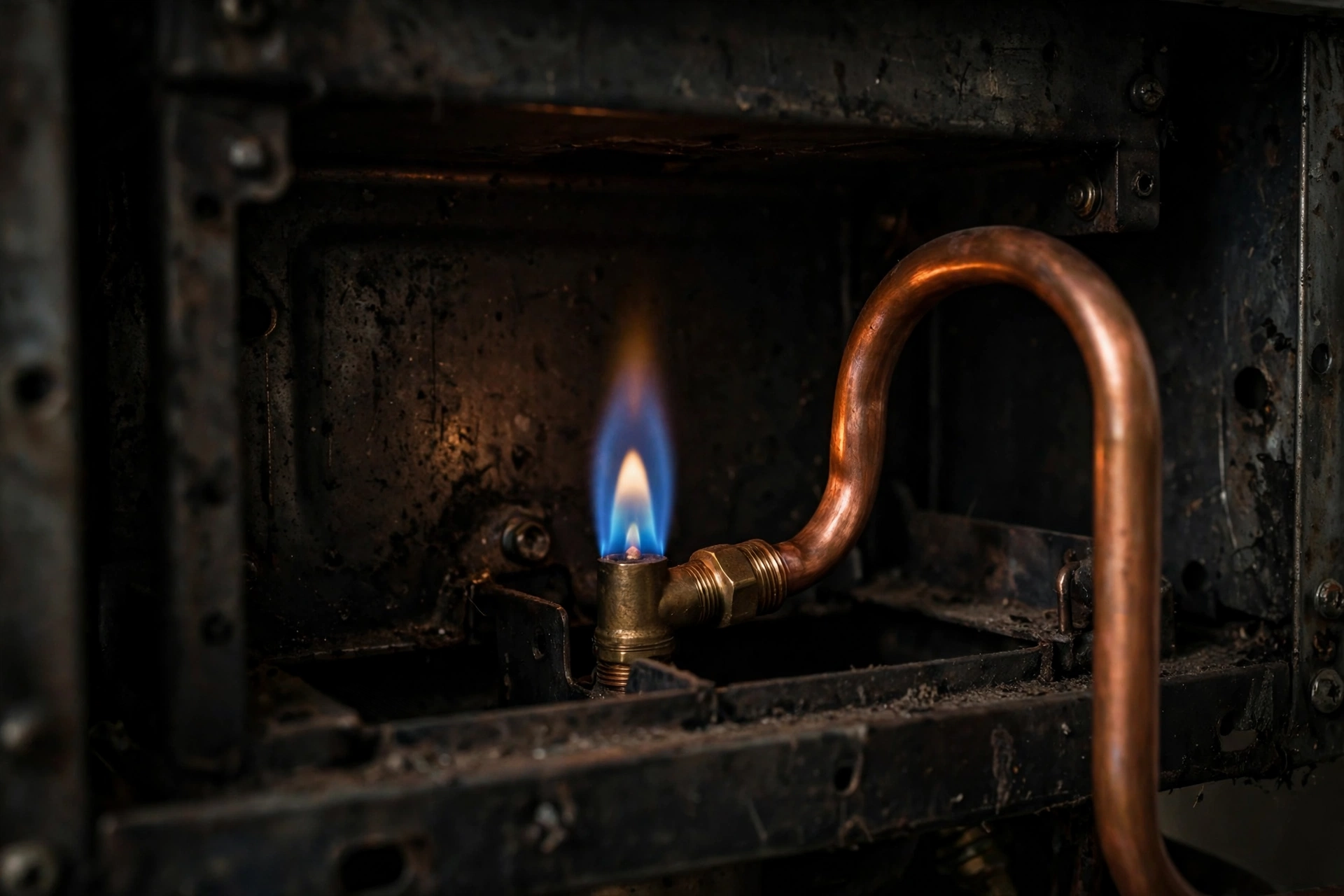
The pilot flame comes through a tiny opening called the orifice, and it does not take much to choke it. Dust and soot collect in there over a heating season, and the flame that comes out is small, yellow, and weak instead of sharp and blue. A weak flame lifts off the thermocouple and dies at the first draft, and relighting it just repeats the same short story.
Flame color is the giveaway. A healthy pilot burns mostly blue with a small yellow tip. A flame that is mostly yellow, lazy, and sooty means the orifice or burner is dirty. Cleaning it means taking the pilot assembly apart, and that is pro work.
What Is Safe to Check Yourself
These checks are safe for a homeowner. Work through them in order.
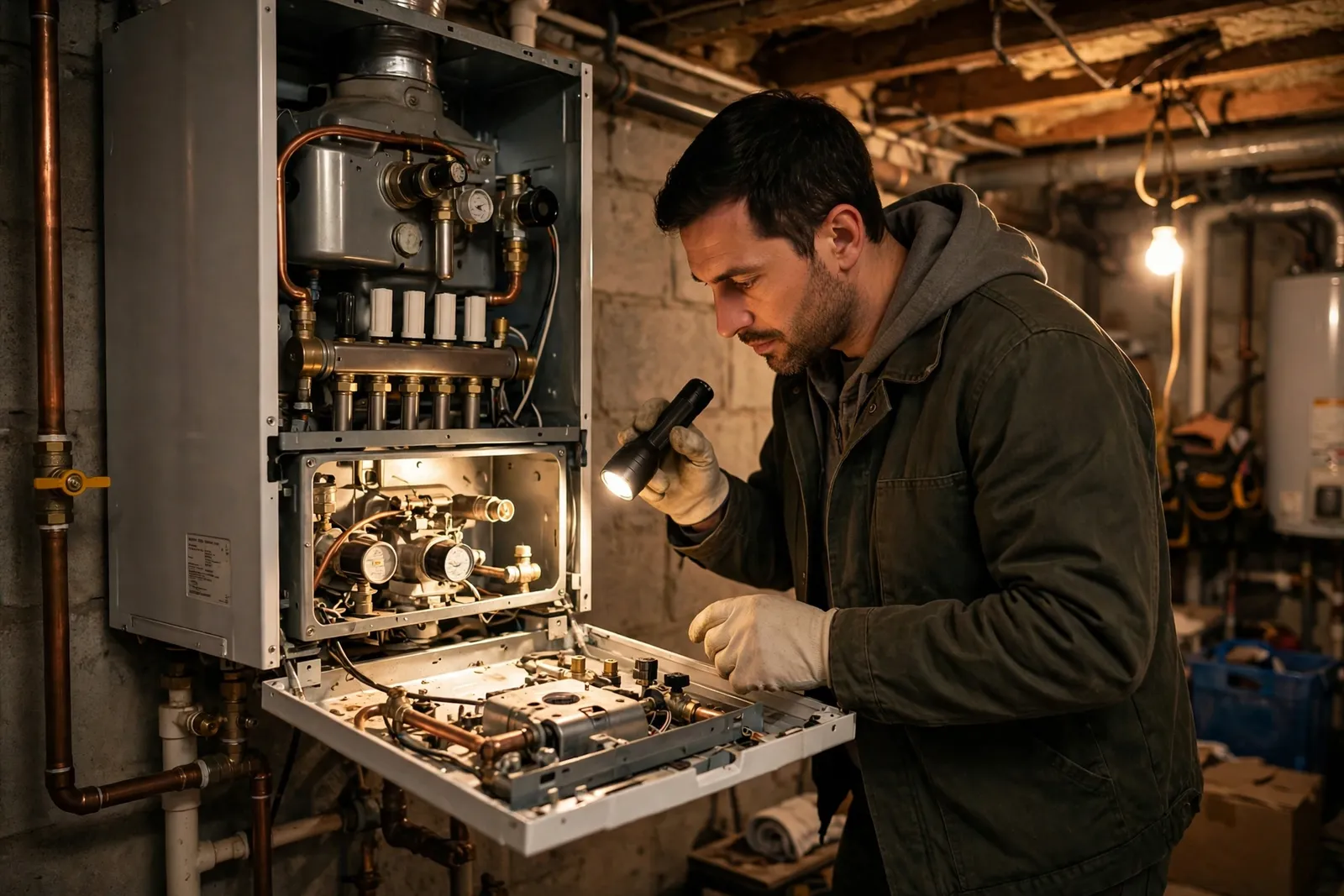
- Look, do not touch the gas fittings. Open the boiler door and look at the pilot with a flashlight. Note the flame color, whether it touches the thermocouple tip, and any soot around the burner.
- Check the other gas appliances. If the stove and water heater are fine, the supply to the house is fine.
- Check for drafts. Is a basement window open or cracked? Is the bulkhead door latched? Did the pilot go out while the dryer ran?
- Check the gas valve. Make sure the shutoff near the boiler is fully open, handle in line with the pipe. Do not force it.
- Relight once, by the book. Follow the lighting instructions on the boiler door exactly, holding the button for the full time stated. If the pilot will not stay lit, stop there.
- Watch it for ten minutes. A good pilot burns steady and blue and holds through a burner cycle.
The most important rule here is about gas smell. If you smell gas, do not relight the pilot, do not flip any switches, and do not use your phone inside the house. Leave, and call your gas utility and a heating pro from outside. A pilot that will not stay lit is an annoyance. Gas in the air is an emergency.
When to Call a Pro Right Away
Some pilot problems can wait. These cannot. Call a pro right away if you smell gas, if the pilot goes out again after one careful relight, if the flame burns yellow and sooty, if there is soot staining around the boiler or flue, or if the carbon monoxide alarm has sounded. A pilot that has gone out several times in a week is also a call.
Call sooner when the boiler is old and this keeps happening through the season. A pilot that dies every night in January will eventually die on the coldest night of the year, when every heating company in Newark is booked solid. A tune-up visit before the deep cold covers the pilot assembly, the thermocouple, the flue draft, and the gas pressure in one pass.
What a Technician Does Differently
A technician does not guess at the pilot, they test it. A thermocouple gets tested for the small voltage it should produce when hot. A weak reading means replacement, not another relight. Gas pressure gets checked at the valve, the pilot assembly gets cleaned, and the flue gets checked for draft and blockage.
A technician also looks at the whole boiler, not just the pilot. A pilot that keeps going out can be the first sign of a gas valve on its way out. If your boiler is past thirty years and the pilot is only the latest in a run of winter problems, our boiler replacement page explains how to weigh one more repair against a new unit, and a visit in Forest Hill or the Ironbound starts with the pilot and ends with an honest read on the whole system.
A pilot light that keeps going out is your boiler asking for attention. Listen to it now, in November, while the weather is still forgiving. Relight it once, check the simple things, and if it goes out again, get it looked at soon.
Related guide: Boiler Short Cycling in Newark: Why It Turns On and Off
Boiler pilot light out again?
Call (973) 275-8278 and tell us whether the flame is blue or yellow and how long the pilot holds.
Call (973) 275-8278