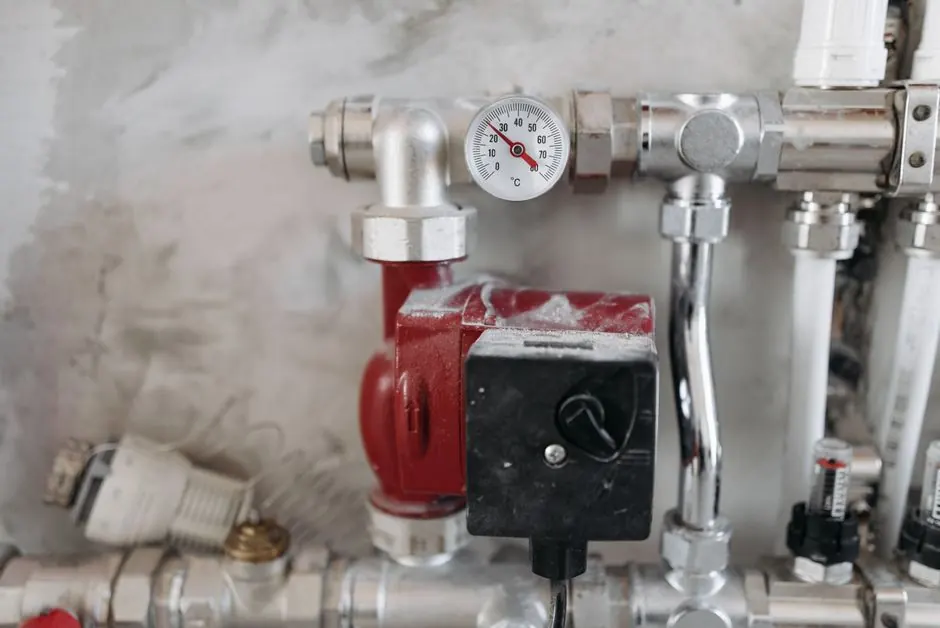
Radiation Survey
Every radiator is measured and its EDR calculated. Mains and risers get a pickup allowance. The total is the boiler's steam load, and the boiler is selected to match it.
Quick Answer
A steam boiler replacement is won or lost before the burner ever fires, in the sizing and the near boiler piping. Brick City Boiler sizes new steam boilers to the building's actual radiation, with proper header, equalizer, and Hartford loop piping, then skims and tests the system. Correct piping is what keeps a new steam boiler quiet and efficient.
Steam boilers are sized to the connected radiation, measured as EDR (equivalent direct radiation), plus a pickup allowance for heating the piping itself. We measure every radiator in the building and size the boiler to that load. The old boiler's size is not a reliable guide: many were oversized decades ago, and an oversized steam boiler short-cycles, surges, and wastes fuel.
Every radiator is measured and its EDR calculated. Mains and risers get a pickup allowance. The total is the boiler's steam load, and the boiler is selected to match it.
Bigger is not better on steam. An oversized boiler makes steam faster than the system can condense it, causing pressure spikes, vent damage, and uneven heat. Right-sizing runs quieter and lasts longer.
The piping design follows the system type. One-pipe systems need correct venting strategy; two-pipe systems need working traps and proper returns. See one-pipe vs two-pipe steam systems.
This is where most steam replacements go wrong. The header, risers, equalizer, and Hartford loop at the boiler separate water from steam. Get it right and the system runs dry and quiet. Get it wrong and no control setting will save it.
The steam header sits high enough above the water line to let water fall back, with proper takeoffs that pull dry steam from the top. Low headers throw water into the mains.
The Hartford loop protects against low-water damage if a return line leaks. It is standard practice on residential steam and part of every replacement we pipe.
The equalizer balances pressure between supply and return so condensate flows home by gravity. Returns are piped to drain freely back to the boiler.
Most residential steam replacements take two to three days. Wondering whether to repair or replace? Our guide when to repair vs replace your boiler walks through the decision.
If the boiler is sound and the problem is venting, piping, or controls, repair is the honest answer. See steam boiler repair in Newark.
What Newark homeowners ask before replacing a steam boiler.
Banging pipes, cold radiators, surging water lines: diagnosed properly on one-pipe and two-pipe systems.
View Steam Boiler RepairProtect the new installation with annual steam service: LWCO testing, skimming, vent checks, combustion tuning.
View Steam Boiler MaintenanceOur general replacement service covers all boiler types when a system is past honest repair.
View Boiler ReplacementNew boiler, old radiators: pitch, vents, and valves get checked so the whole system performs.
View Radiator Repair & InstallationBoiler died mid-winter? Emergency service gets heat back first, replacement planning second.
View Emergency Boiler RepairMost Newark steam boilers burn gas. Gas-side setup and tuning are part of every steam installation.
View Gas Boiler ServicesPlanning a steam boiler replacement? Tell us about the building, the current boiler, and where in Newark or Essex County you are, and we will take it from there.
You call
Tell us about the building and the boiler. We will ask a few quick questions.
We survey
Radiation measured, piping evaluated, boiler sized to the actual load.
You get it in writing
The full scope and plan in writing before any work starts. No surprises, ever.
Phone
(973) 275-8278Address
Newark, New Jersey
Visit Us
53 Irvine Turner Blvd, Newark, NJ 07103, USA